Dining Room Ideas for 2026: 90 Fresh Looks to Try
Your dining room doesn’t need a full renovation to feel new. Most of the time, it needs three things: a color that isn’t fighting the room, lighting that flatters people (not just the table), and a layout that matches how you actually live, not how a showroom told you to live.
Dining room ideas cover the colors, furniture arrangements, lighting choices, and layout decisions that turn an underused room into the one people gravitate toward. The best ones solve a specific problem: a dark corner, an awkward nook, a table nobody sits at. They don’t chase a single trending aesthetic.
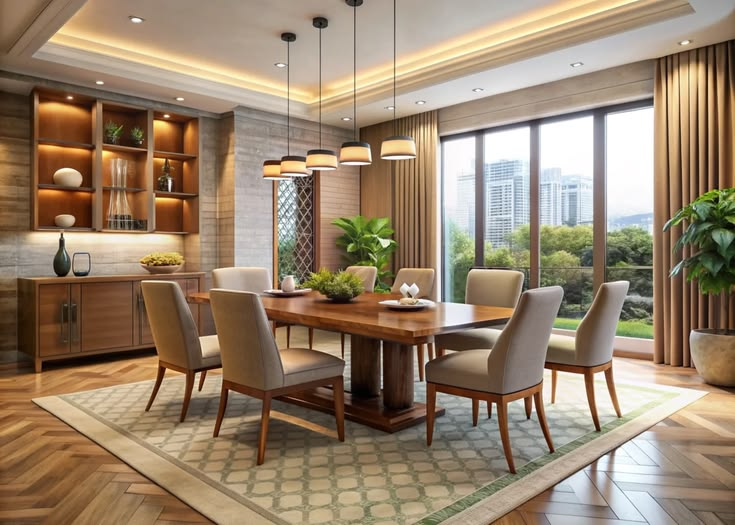
Is the Dining Room Even Back? (Yes, Here’s the Data)
Quick note: if you’ve been told open-concept killed the dining room, that’s not quite right.
There’s been a real shift back toward dedicated dining spaces after years of open-plan dominance, according to Homes & Gardens’ 2026 trends coverage. Homeowners aren’t abandoning open layouts entirely. They’re just no longer assuming open-concept is the only “modern” option.
Most people assume a separate dining room is a luxury only bigger homes can afford. The data says otherwise, and so does the design world. Designers are increasingly carving out dining zones inside hallways, converted nooks, and the “dead” corner of a living room, precisely because full-time dining rooms felt wasteful in smaller homes for a while. That’s changing.
Quick Comparison
| Layout Option | Best For | Key Benefit | Limitation |
|---|---|---|---|
| Dedicated dining room | Larger homes, frequent hosting | Fully flexible styling, no compromise with other functions | Can sit unused most weeknights |
| Open-concept dining | Small-to-mid homes, everyday families | Feels social, maximizes square footage | Mess and noise from the kitchen stay visible |
| Hallway or nook dining | Apartments, entryway-heavy homes | Turns “wasted” space into function | Limited seating capacity |
| Multi-purpose dining | Work-from-home households | One room does double duty (desk + dinner) | Requires more intentional furniture choices |
Here’s the thing: the right layout isn’t the trendiest one. It’s the one that matches how often you actually eat at a table versus a couch.
Choosing Your Layout Before You Choose a Style
Pick your layout first. Style second. This is the order most Pinterest boards skip, and it’s why so many dining room “refreshes” don’t stick.
If You Have a Dedicated Room
Lean into it. A dedicated dining room can carry a bolder wallpaper, a statement chandelier, or a round table that wouldn’t work in a tighter footprint. This is the space where matching furniture sets are finally being replaced. Mixed seating (a bench, two upholstered captain’s chairs, and wood side chairs) reads as intentional rather than mismatched, as long as the fabric and finish tones stay in the same family.
If You’re Working With Open-Concept
Define the zone visually instead of physically. A rug under the table, a pendant light cluster, or a slightly different wall tone signals “this is the dining area” without adding walls. To achieve a defined open-concept dining zone, follow these steps:
- Anchor the space with a rug at least 24 inches wider than the table on all sides.
- Drop a pendant or linear fixture centered over the table, 30–34 inches above it.
- Choose one accent color that doesn’t repeat in the adjoining kitchen or living zone.
If You’re Working With a Small Nook or Hallway
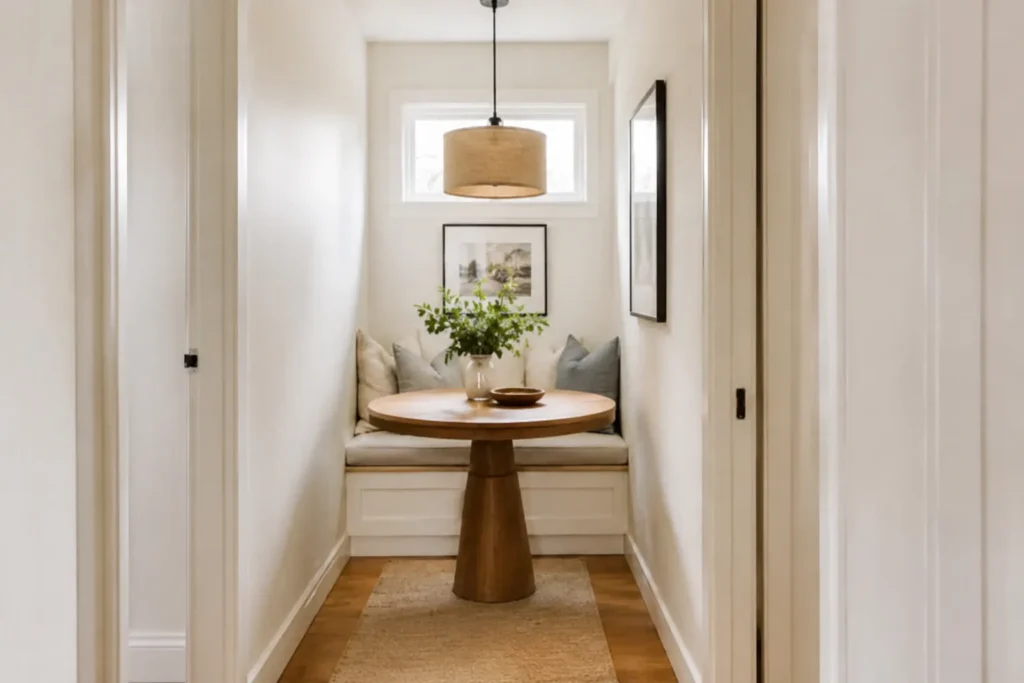
This is where a hall-dining setup, placing a table in an entryway or wide hallway, is having a real comeback. It works because it doesn’t require a dedicated room, and the table can double as a display surface between meals.
Dining Room Color Ideas Designers Are Actually Using
Stark white minimalism is on its way out. Designers are naming it directly: an all-white, ultra-clean dining room can slide into feeling cold and impersonal fast, especially without texture to balance it out.
What’s replacing it isn’t maximalism, necessarily. It’s warmth with a point of view.
- Earthy neutrals (warm beige, soft taupe, greige) remain the safest, most resale-friendly base layer.
- Muted color accents (sage, dusty blue, clay, and terracotta) show up on chairs, linens, or a single accent wall rather than the whole room.
- Jewel tones and deeper hues are appearing on cabinetry, buffets, and trim in dedicated dining rooms specifically, where there’s less pressure to keep things neutral for resale.
I’ve seen conflicting advice on this. Some sources push all-neutral “quiet luxury” schemes; others are fully behind moody, saturated dining rooms. My honest read: if the room only gets used for meals and hosting, you can take more color risk than in a room you’re in constantly. Dining rooms are one of the few places in the house where a bold choice doesn’t wear you out day to day.
Dining room colors, side by side: warm neutrals work better for resale value and rooms that double as a workspace or homework station, because they stay flexible. Jewel tones and deeper colors work better in dedicated, occasion-driven dining rooms, because the room isn’t asking to feel calm all day. It’s asking to feel special for a couple hours.
Lighting Ideas That Change the Whole Room
Lighting does more heavy lifting in a dining room than almost any other design choice, and it’s the one most people get wrong first. A single overhead fixture, cranked to full brightness, flattens a room and washes out faces.
What most guides skip is layering. A dining room needs at least two light sources: a statement fixture over the table, and something softer (sconces, a buffet lamp, or dimmable candles) for ambiance once the sun goes down.
Oversized single chandeliers are being quietly retired in favor of smaller-scale, warmer alternatives: think a cluster of three pendants, a linear fixture over a rectangular table, or a scaled-down chandelier that doesn’t dominate the ceiling. The goal isn’t less light. It’s more control over it.
Small and Awkward Dining Space Ideas
Not every dining space gets to be a full room, and competitor round-ups tend to skip this part almost entirely.
Apartment dining nooks. A drop-leaf or extendable table solves the “seats 4 or seats 8” problem without permanently eating your square footage. Bench seating on one side saves 8–10 inches of clearance compared to chairs.
Combo living-dining rooms. Use a rug to split the floor plan, and keep the dining side furniture lower-profile (a bench, armless chairs) so sightlines to the living area stay open.
Kitchen-adjacent nooks. A banquette with storage underneath handles two problems at once: seating, and the fact that most nooks lack a coat closet or sideboard nearby.
Studio or one-room living. A round table pushed against the wall, pulled out only when needed, keeps a single-room layout from feeling like it’s permanently set for dinner.
Budget-Tiered Shopping Picks
Here’s the thing: you don’t need a full designer budget to get a designer look. You just need to spend on the right two or three pieces.
- Splurge tier: Studio McGee (McGee & Co.) for statement lighting and case goods with a distinct point of view.
- Mid tier: Serena & Lily for coastal-adjacent, texture-forward furniture and linens that photograph well without looking staged.
- Accessible tier: Pottery Barn and Wayfair for mix-and-match dining chairs, extendable tables, and rugs at a range of price points.
small space furniture guide → “furnishing a small dining nook”
Dining Room Ideas: Quick Answers
Q: What’s the best dining room layout for a small apartment? A: A hallway or nook setup with an extendable table. It uses otherwise wasted space and adapts seating up or down as needed.
Q: How do I light a dining room without a formal chandelier? A: Layer a linear pendant or pendant cluster over the table with dimmable sconces or lamps around the room’s perimeter.
Q: Should I match all my dining chairs? A: No. Mixed seating in a consistent color palette is the current preference over matched sets, and it’s easier to adapt as pieces wear out.
Q: What dining room colors are designers moving away from? A: Stark, all-white minimalist schemes. Warmth and texture are replacing that look, even in otherwise neutral rooms.
Q: Is a separate dining room worth it in a small home? A: It depends on how often you host. If it’s rare, a hybrid nook or multi-purpose zone usually makes more sense than a rarely-used dedicated room.
Where This Guide Stops
This guide covers layout, color, lighting, and small-space fixes for dining rooms. It doesn’t cover full structural renovations: knocking down walls, adding square footage, or built-in banquette construction. Those call for a contractor, not a shopping list.
Homes & Gardens 2026 Dining Room Trends → source for the dedicated-dining-room resurgence data
About The Author
